
Understanding the Escalation Cycle: A Guide to De-escalation When Working with Domestic Violence Survivors
By Melissa Roark, MA, LPCC | May 24th, 2024
Crisis is not a character flaw. It is a neurological event. When a domestic violence survivor — or anyone who has experienced prolonged trauma — enters a state of emotional crisis, their brain has not "broken." It has done exactly what it was designed to do: shift into survival mode to protect itself from perceived threat. For clinicians working in shelter settings and for clients navigating the ongoing work of healing, understanding this process — and how to respond to it skillfully — can be the difference between a moment that deepens shame and a moment that builds resilience.
De-escalation is both a clinical skill and a relational practice. It is not about controlling behavior — it is about becoming a steady, regulated presence that guides another person's nervous system back to safety. This blog post walks through the seven phases of the escalation cycle and what both clinicians and clients need to know about each one.
The Brain During Crisis: Why It Happens
During a crisis, the brain enters survival mode. The prefrontal cortex — responsible for rational thought, decision-making, and impulse control — goes offline, while the more primitive limbic system takes over. Survivors experience an intense "energy surge" that effectively detaches them from their thinking mind. This is not a choice. This is neurological wiring responding to real or perceived threat.
For domestic violence survivors, this threat response is particularly sensitive and easily triggered. Years of living in a state of hypervigilance have recalibrated the brain's alarm system, making it more reactive and harder to self-regulate without support. Understanding this is not an excuse for behavior — it is essential context for why de-escalation must be trauma-informed, patient, and grounded in compassion rather than authority (Wisconsin DPI, 2021).
The Escalation Cycle
The escalation cycle illustrates the pattern that occurs before, during, and after a crisis episode. It moves through seven distinct phases — Calm, Trigger, Agitation, Acceleration, Peak, De-escalation/Depletion, and Recovery — and then ideally returns to a baseline of calm. Each phase requires a different clinical response.
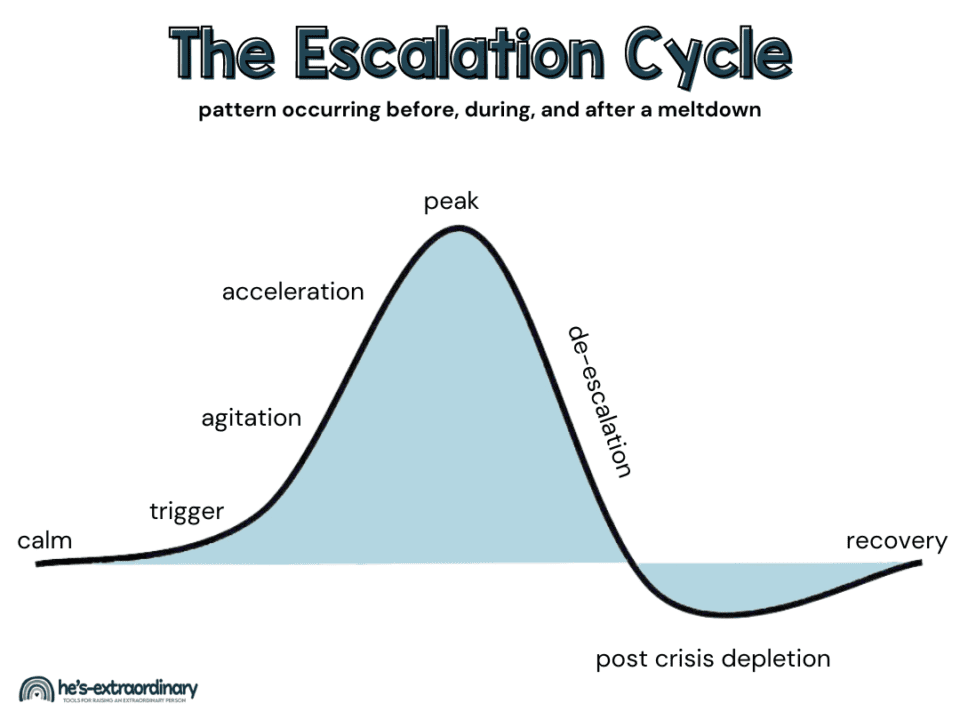
Figure 1: The Escalation Cycle — pattern occurring before, during, and after a crisis (He's Extraordinary)
Phase 1 — Calm: The Window of Opportunity
The calm phase is the most powerful — and most underutilized — stage of the entire cycle. This is when the client is cooperative, engaged in their treatment or housing plan, and most able to learn, process, and connect. For clinicians and advocates, this is the time to establish clear, collaborative behavioral expectations; to communicate what clients can expect from you (and hold to it); to build consistent routines; and to check your own personal biases and triggers before they affect your interactions during harder moments. For clients, this is the time to reflect on what helps you feel safe, what your known triggers are, and what tools work best for you when stress begins to rise (Strickland-Cohen et al., 2022).
Phase 2 — Trigger: Prevention and Redirection
A trigger is the moment unresolved conflict begins to surface. For DV survivors, triggers may be obvious — a raised voice, a closed door, a specific phrase — or they may be subtle and seemingly unrelated to the shelter environment. Clinicians should be alert to early behavioral signs: a change in tone, withdrawal, or increased rigidity. The most effective tool at this phase is respectful curiosity. Navarro (2017) reminds us that non-verbal communication carries enormous weight when someone is in distress — the more escalated a person becomes, the less they process words and the more they respond to tone, posture, and proximity. Keeping your body language open and neutral, respecting personal space, and actively listening without interrupting can prevent a trigger from becoming a full agitation response.
For clients: if you notice your heart rate rising, your thoughts racing, or an urge to withdraw or react, you are likely in the trigger phase. This is the moment to use a grounding technique, reach out to a trusted support person, or simply name what you are feeling — "I'm feeling overwhelmed right now" — before the wave builds.
Phase 3 — Agitation: Reducing Anxiety
During agitation, the client is experiencing unfocused anxiety. Emotions are elevated and beginning to feel unmanageable, but the person has not yet fully lost access to their rational mind. This is a critical window. Clinicians should validate feelings without judgment — because those feelings are real, regardless of whether the situation that triggered them seems proportionate. As Oud (2021) notes, validation is one of the most powerful tools for reducing emotional intensity. Offering simple, achievable options (rather than demands), providing a quiet space if possible, and allowing brief disengagement — a short walk, a few minutes alone — can interrupt the upward spiral before it reaches acceleration.
Phase 4 — Acceleration: Increasing Safety
Acceleration is characterized by focused, intense anxiety. The thinking brain is now significantly compromised, and the client is approaching the point of losing control. Clinicians must first pause and assess: Is this an emergency situation? If not, the goal is to avoid adding fuel to the fire. This means refraining from raising your voice to match theirs, avoiding power struggles, and offering only a small set of clear choices — the brain in this state cannot process complexity. A calm but direct tone communicates safety and control. If you are the trigger for the resident — even unintentionally — it is appropriate and professional to step back and allow a colleague to take over the de-escalation (Crisis Prevention Institute, 2021).
Phase 5 — Peak: Crisis Intervention
At the peak, the client is in full survival mode, completely detached from their rational mind. This is the moment of maximum behavioral dysregulation. It can feel frightening and chaotic — but it is important for clinicians to remember that this emotional outburst is a reaction to the abuse the survivor has endured, not a reflection of who they are as a person. Your role here is not to reason or persuade. Your role is to be a steady, regulated presence — what the presentation describes as a "rock in an ocean." Remove others from the space, eliminate hazardous objects, contact additional support if needed, and continue speaking calmly if possible. Monitor your own internal state closely; your calm is contagious, and so is your panic.
Phase 6 — De-escalation and Depletion: Removing Excess Attention
After the peak, the body begins to deplete its crisis energy. The client may become quiet, confused, tearful, or even fall asleep. This is a normal physiological response — the nervous system is exhausted from the intensity of what just occurred. Clinicians should give space and silence without abandoning the client. Avoid blame and avoid rehashing what happened immediately. Offer small, simple tasks that restore a sense of control and agency. Document the incident thoroughly to inform future safety planning. This phase can be lengthy — resist the urge to rush it.
Phase 7 — Recovery: Debriefing and Re-engagement
Recovery is where the most meaningful clinical work happens. Once the client has returned to a regulated baseline, a non-judgmental debrief opens the door for insight, growth, and future planning. Clinicians should focus on strengths — what the client did well, even in the midst of the crisis — and collaboratively develop a prevention plan for future episodes. Ask questions like: "What helps you feel safe here? What was the biggest stressor leading up to this moment? Is there something we can work on together?" Planned consequences should be followed through consistently and without negotiation, as maintaining healthy limits is itself a modeling intervention. For clients, this is the phase to be gentle with yourself. A crisis is not a failure. It is information — about your nervous system, your needs, and what supports you require to keep healing (Wisconsin DPI, 2021).
Trust the Process — For Clinicians and Clients Alike
We cannot control what happens in the world. We can only control how we respond to it. For clinicians and advocates working with DV survivors, de-escalation is not a technique applied to a difficult person — it is a relational bridge built between two nervous systems, one of which is trying to find its way back to safety. You may not always see the outcome of your efforts. Many survivors will leave treatment before the healing is complete. But people remember when they were treated with respect and dignity in their most vulnerable moments. That memory becomes part of the foundation on which they rebuild.
For clients reading this: the escalation cycle is not a life sentence. It is a pattern — and patterns can be interrupted, reshaped, and eventually rewired. With the right support, the right environment, and enough time, the peaks get lower, the recoveries get faster, and the calm phases grow longer. You are not your crisis. You are the person learning to navigate it.
References
Crisis Prevention Institute. (2021). CPI's top 10 de-escalation tips. crisisprevention.com.
Navarro, J. (2008). What every BODY is saying. HarperCollins.
Navarro, J. (2017). The dictionary of body language. HarperCollins.
Navarro, J. (2021). Be exceptional: Master the five traits that set extraordinary people apart. HarperCollins.
Oud, A. M. (2021). The importance of validation. Psychology Today.
Strickland-Cohen, M. K., Newson, A., Meyer, K., Putnam, R., Kern, L., Meyer, B. C., & Flammini, A. (2022). Strategies for de-escalating student behavior in the classroom. Center on PBIS, University of Oregon. www.pbis.org.
Wisconsin Department of Public Instruction. (2021, September). The response cycle. dpi.wi.gov.
